﷽
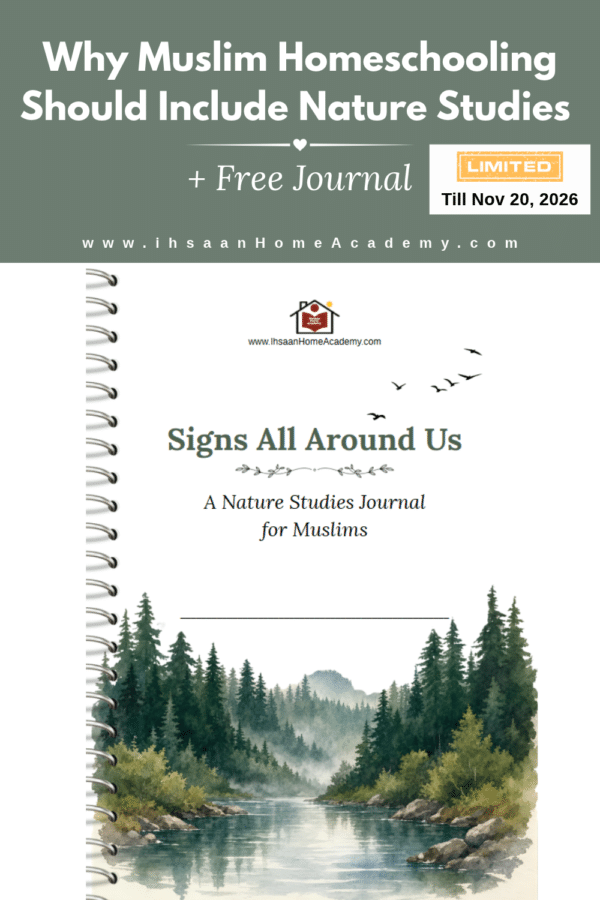 Maybe I shouldn’t say “should,” but I highly recommend it. Nature Studies is a beautiful addition to Muslim homeschooling because it gives our children an opportunity to learn about the world around them while strengthening their appreciation of the One who created it. When we make time to observe nature, we give our children opportunities to develop curiosity, ask questions, discover how things work and grow in gratitude for the countless blessings Allah has placed around us. Learning about nature becomes more than a science lesson; it becomes an opportunity to nurture wonder, reflection and a deeper appreciation of the Creator.
I would like to share something from the Nature Studies Journal printable I’ve shared below…
____________
The world around us is full of beautiful things to discover. From the tiniest insects crawling through the grass to the tallest trees reaching towards the sky, every part of creation gives us something to wonder about.
As Muslims, we know that all of this is from Allah. He has created the heavens and the earth, the mountains and the seas, the plants and the animals, us humans and everything in between. In the Qur’an, Allah repeatedly invites us to look around us, to think, reflect and recognize the signs of His greatness in the world He has created.
Allah says:
“Indeed, in the creation of the heavens and the earth and the alternation of the night and the day are signs for those of understanding.” Surah Ali ‘Imran (3:190)
Studying nature is an opportunity to slow down and pay attention to these signs. It is a chance to step outside when we can and notice the little things we might otherwise overlook or take for-granted. Watch how a flower opens, listen to the birds, observe the clouds, feel the breeze or follow the path of a tiny ant. Some of these can even be done at home. You can start pondering anywhere, anytime, inshaa Allah.
I remember a night right before Fajr when I could hear birds chirping outside. I had just finished praying, was sitting on a mat and paused for a moment. What made me pause was how beautiful it sounded and the fact that I had never noticed it around that time. I started wondering if the bird were praying since it was shortly before dawn. I immediately thought of the ayah,
“Do you not see that Allah is exalted by whomever is within the heavens and the earth and [by] the birds with wings spread [in flight]? Each [of them] has known his [means of] prayer and exalting [Him], and Allah is Knowing of what they do.” Surah An-Nur (24:42)
Be curious and ask questions. Wonder why things happen and how Allah has made them work. We may not always have the answers, but wondering allows us to ponder and appreciate the smallest to the biggest things around us. Look closely, explore and take time to appreciate even the smallest details. Everything is purposeful, even when we don’t know it.
As you discover more about the world, remember to be grateful. Every leaf, drop of rain, living creature and every new day is a blessing from Allah.
“And with Him are the keys of the unseen; none knows them except Him. And He knows what is on the land and in the sea. Not a leaf falls but that He knows it. And no grain is there within the darkness(es) of the earth and no moist or dry [thing] but that it is [written] in a clear record.” Surah Al An’am (6:59)
May Allah make your time in nature be a means of increasing your knowledge, deepen your appreciation of His creation and remind you of just how much there is to be thankful for.
Ameen
You May Also Like:
Plant and Crop Growing Journal
___________
If you agree with the above mentioned and would like to start incorporating nature studies in your homeschooling, you can download the free journal by clicking the link below. Of course you don’t have to and definitely don’t need a guided journal/notebook to start. You can simply get any regular lined/dotted or blank notebook.
Here are some ways you can use it:
First of all, this isn’t only for children or homeschooling. Anyone can benefit from observing nature and writing observations in a journal or notebook.
- Nature Walks: Take regular walks and record interesting things you notice along the way, such as plants, insects, birds and trees.
- Plant Studies: Choose a plant or flower to observe. Draw it, label its parts and record how it changes over time.
- Bird Watching: Observe birds in your garden or local area. Record their colors, sizes, sounds and behaviors.
- Insect Studies: Explore the world of insects. Observe their features, habitats, movements and life cycles.
- Weather Observations: Keep track of daily weather, cloud formations, rainfall, wind and seasonal changes.
- Tree Studies: Choose a tree and observe its leaves, bark, flowers, fruits and changes throughout the seasons.
- Seed to Plant: Plant a seed and record its growth through drawings, measurements and observations.
- Animal Studies: Choose an animal to learn about. Record its habitat, diet, physical features and interesting behaviors.
- Rock & Soil Studies: Examine different rocks, stones and types of soil. Compare their colors, textures and characteristics.
- Moon Watching: Observe the moon over several weeks and record how its appearance changes.
- Cloud Watching: Look at different cloud formations, identify their types and record what you notice about the sky.
- Seasonal Studies: Observe how nature changes throughout the year. Record changes in plants, trees, weather and animal activity.
- Nature Collections: Collect fallen leaves, feathers or other suitable natural treasures (where permitted) and use them for observation, drawing and identification.
- Nature-Inspired Research: Choose something you have spotted outdoors and use books or other resources to learn more about it.
- Allah’s Creation Reflections: Choose something in nature and reflect on its beauty, purpose and the blessings it provides. Record something that makes you grateful to Allah.
- Nature Sketching: Spend time drawing what you see. Practice noticing small details, shapes, patterns and textures.
- Following a Life Cycle: Observe the life cycle of a plant, butterfly, frog or another suitable subject through books, videos or direct observation.
- Backyard Discoveries: Explore your own garden, balcony or nearby outdoor space. You might be surprised by how much there is to discover!
Some Books About Nature I Recommend:
Nature Studies doesn’t need to involve elaborate projects or lengthy lessons. Even 15–20 minutes of outdoor observation can become a meaningful learning experience. Encourage your children to notice, wonder, ask questions and reflect. The simplest discoveries can lead to wonderful learning opportunities. You also don’t need to aim for filling out your nature journal. Record whatever you want to record. It could be a sentence, a drawing or simply saying “Alhamdulillah for this beautifully fragrant flower on my patio.”
There’s nothing on this earth that can’t take our mind back to the Creator. He created even our mind; so let’s start with that.
I hope this article was meaningful to you. And if it was, kindly share it with others who may also benefit. Comment below if you have any questions or something to share.
Jazak Allahu khayr
Get the Nature Studies Journal HERE
(FREE Until November 20, 2026)
Some links are affiliate links, meaning I may earn a small commission if you purchase through them, at no extra cost to you. You’ll pay the same price either way, and your support helps keep IHA going. Thank you!
Get Free Resources & Updates
Join to receive free resources, blog updates & special offers straight to your inbox.
You're in! Please check your inbox to confirm.